"What was the basis of panic that led the lights to darken on civilization?
The most important date here might be March 11, 2020. That’s when Congress itself flew into an unwarranted panic, and acquiesced to a lockdown at the urging of the “experts.” State governors followed one by one, with few exceptions, and the rest of the world joined the lockdown frenzy.
In February, people were aching to know the answer to the following. Would this “novel virus” have familiar patterns we associate with the flu, seasonal colds, and other predictable and manageable pathogens? Or would this be something entirely different, unprecedented in our lifetimes, terrifying, and universally deadly?
Crucial in this stage was public-health messaging.
...Something dramatically changed this time. They pushed panic...
...What has been different has been the messaging that has almost universally been structured to create public frenzy, from the New York Times’s February 28 urge to “go medieval” to Salon’s latest demand that we panic even more.
...It was a seemingly small error but it provided the basis on which Anthony Fauci testified at the House Oversight and Reform Committee about the seriousness of novel coronavirus spreading across the globe.
Here is the video in question. As you watch, you will note the seeming precision of data that actually masks a huge problem. He obscures the huge difference between the infection fatality rate, the case fatality rate, and the overall death rate. Nowhere does he mention survival rates. Not one person present pushed back on his claims. In the blizzard of data, he finally summarizes in a way that terrified everyone. Covid, he said, is “10 times more lethal than the seasonal flu.”
Even apart from that prediction, his entire demeanor was: this is entirely new, very deadly, and unbearably unmanageable without extreme measures.
Fauci’s implicit message to Congress and the American people was that it is time to panic.
Fauci was claiming what in fact he could not know, conflating two distinct data sets, and extrapolating in ways that allowed him to make a completely unsupported claim that very obviously turned out to be false. Two years ago, 61,000 Americans of all ages died of flu, exclusive of other ailments. If you incorrectly impose on that a “case fatality rate” of 0.1% and extrapolate to Covid infections, you end up with at least 800,000 deaths from Covid alone – not “with” or “involving” Covid as the CDC classifies deaths today (that alone represents a big change). This is a scary prediction at the time; it seemed to add weight to the estimates out of the Imperial College of London that 2.2 million people would die without locking down. This testimony led a whole generation of lawmakers to believe that none of the traditional medical measures could or would work. There is no comparing this with the flu or any respiratory illness. This was the Other that justified a once-in-many-generations national emergency that required an end to our way of life.
The trouble is that the whole claim was based on a terminological misstatement that fed a basic math error. As Brown explains:
Sampling bias in coronavirus mortality calculations led to a 10-fold increased mortality overestimation in March 11, 2020, US Congressional testimony. This bias most likely followed from information bias due to misclassifying a seasonal influenza IFR as a CFR, evident in a NEJM.org editorial. Evidence from the WHO confirmed that the approximate CFR of the coronavirus is generally no higher than that of seasonal influenza. By early May 2020, mortality levels from COVID-19 were considerably below predicted overestimations, a result that the public attributed to successful mitigating measures to contain the spread of the novel coronavirus.
Let’s follow Brown here as he takes the reader through the crucial differences between the IFR and the CFR. IFRs from samples across the population “include undiagnosed, asymptomatic, and mild infections.” To calculate the average IFR across the population, you do randomized samples to judge its prevalence. The results are inclusive of cases – what we used to call actual “sick” people – but extend to people who merely carry traces of the dead virus but are in no substantial danger of passing it onward or experiencing any severe outcomes. Cases, on the other hand, “are based exclusively on relatively smaller groups of moderately to severely ill diagnosed cases at the beginning of an outbreak.” The CFR is a smaller group. Brown provides the following graphic to show how epidemiology has long considered the difference.
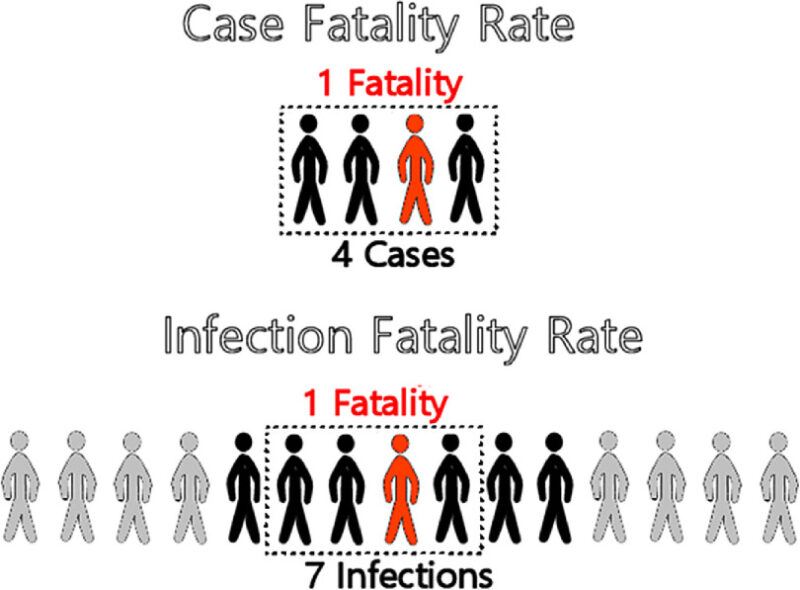
Based on this graphic alone, you can see why it becomes crucial to keep these terms straight. The CFR is higher; IFR is lower; the crude mortality rate is lower still. The CFR measures severity; the IFR measures prevalence.
...Flipping the data to state it by survival rate by age:
- 99.997% for 0-19 years
- 99.98% for 20-49 years
- 99.5% for 50-69 years
- 94.6% for 70+ years
John Ioannidis sums up the disparity by age with the following infection fatality rate for people under the age of 70: 0.05%. This conclusion has been peer-reviewed and published by the World Health Organization.
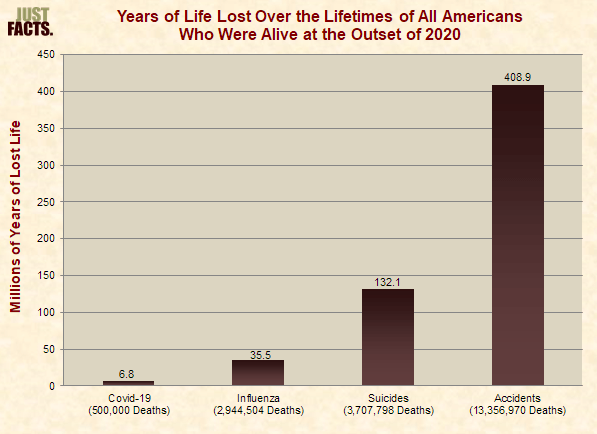
...However, we can assemble the data based on years of lost life. Consider the long-term view over the future course of existing lifetimes. JusttheFacts reports:
If 500,000 Covid-19 deaths ultimately [in the future] occur in the United States—or more than twice the level of a prominent projection—the disease will rob about 6.8 million years of life from all Americans who were alive at the outset of 2020.
In contrast:
* the flu will rob them of about 35 million years.
* suicides will rob them of 132 million years.
* accidents will rob them of 409 million years.
...What we know is that a terminological confusion, a misplaced decimal point, a one-word error in data description, and a massive amount of arrogant presumptions about how to control a virus set in motion a series of events that turned our great and prosperous country into a disaster of confusion, demoralization, foregone medical services, closed businesses, wrecked arts and education, and long bread lines.
The lockdowners who created this appalling disaster, the people who turned our trust into betrayal and a blizzard of statistical baloney, need to look at the science and data as they stand and come clean."

No comments:
Post a Comment